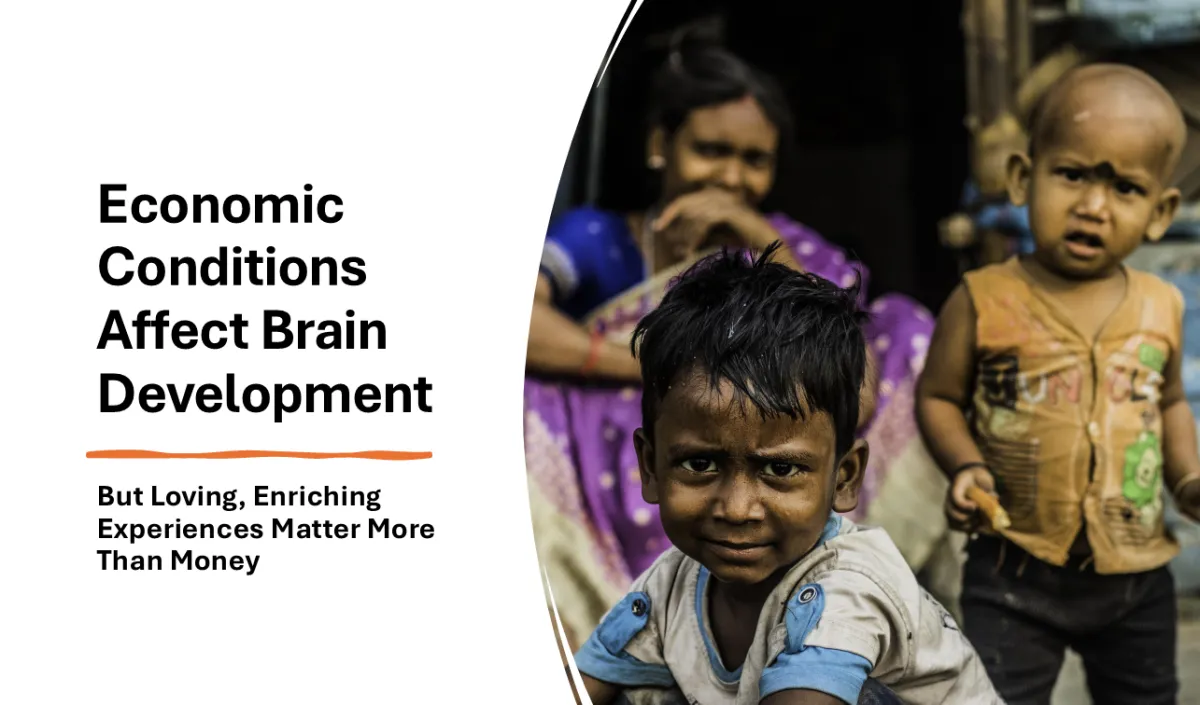
Economic Conditions Affect Brain Development — But Loving, Enriching Experiences Matter More Than Money
Over the past few decades, developmental research has helped us understand something deeply important:
a child’s environment shapes the developing brain.
Some studies have shown that children raised in economically impoverished circumstances tend to have subtle differences in certain brain structures. For instance, the surface area of the brain’s outer layer (the cerebral cortex) is often slightly smaller, particularly in regions associated with language, self-regulation, and impulse control. Other research has found that the hippocampus, a brain region involved in memory and learning, may have a lower volume in children growing up in chronic poverty.
At first glance, this information can feel discouraging — even frightening.
But here is the crucial truth:
These findings are not destiny.
They are context, not condemnation.
Developmental psychologists consistently emphasize that brain development is highly responsive to experience, especially in early childhood. And the most powerful experiences do not come from expensive toys, elite schools, or paid programs. They come from relationships, movement, language, play, rhythm, and meaningful participation in everyday life.
In other words:
Nurturing brain development does not require wealth. It requires presence.
The Brain Grows Through Experience, Not Purchases
The developing brain is shaped by repeated patterns of experience.
Every cuddle, conversation, movement, and shared moment strengthens neural connections.
What children in poverty often lack is not intelligence or potential — it is consistent access to rich, varied experiences. And this is mainly because the parents need to dedicate a huge amount of focus to earn money. That is taxing, it is draining, and it affects children. The good news is that these experiences are available to almost every family, regardless of income.
Let’s explore how parents and caregivers — especially those with limited financial resources — can support optimal brain development using what they already have.
1. Physical Experiences: Touch Builds the Brain
Human touch is one of the earliest and most powerful organizers of the brain.
Simple physical experiences such as:
cuddling
skin-to-skin contact
holding and rocking
tickle games
gentle massage
playful wrestling
all stimulate the nervous system in healthy ways. These experiences strengthen emotional regulation, body awareness, and the brain’s stress-response systems.
For babies and young children, touch communicates safety. And a brain that feels safe is a brain that grows well.
None of this costs money.
It only costs time and attentiveness.
2. Linguistic Experiences: Language Is Built Through Conversation
Language development does not begin with alphabet charts.
It begins with being spoken to.
Talking with children — not at them — builds vocabulary, grammar, and comprehension naturally. Narrate your day. Ask questions. Respond to their sounds and gestures. Sing to them. Tell stories.
Reading aloud is especially powerful because it engages multiple senses at once:
hearing the words
seeing the pictures
feeling the closeness of being held
Books don’t need to be fancy. Old books, borrowed books, shared books, or even handmade story cards work beautifully. What matters is the shared attention and emotional warmth.
3. Artistic Experiences: Expression Before Perfection
Art is not about producing beautiful outcomes.
It is about expressing inner experience.
Give children paper and pencils. Crayons. Charcoal. Chalk. Old newspapers. Mud and sticks.
With crayons and pencils, they will scribble at first — and that is exactly what they should do.
Scribbling builds:
fine motor control
visual-motor integration
creativity
emotional expression
Paints can be homemade. Brushes can be fingers. Art materials do not need to be expensive — they need to be open-ended.
4. Sensorial Experiences: The World Is the Classroom
The brain grows by processing sensory input.
Children need:
rough and smooth textures
hard and soft surfaces
warm and cool sensations
wet and dry experiences
Let them touch different fabrics.
Let them walk barefoot on grass.
Let them play with water, sand, soil, leaves, and stones.
These sensorial experiences help organize the brain’s sensory systems — a foundation for attention, learning, and emotional regulation later in life.
Nature, especially, is a free and powerful teacher.
5. Rhythmic Experiences: The Brain Loves Rhythm
Rhythm helps regulate the nervous system.
Music, clapping, chanting, dancing, and movement all activate large networks in the brain. Children don’t need instruments — pots, spoons, containers, and hands are enough.
At first, expect noise. Loud, chaotic noise.
That’s normal.
Rhythm develops gradually through repeated exposure.
Dance with your children. Carry them while you sway. Move together. I often dance around the house holding my one-year-old in my arms — not to teach him anything formally, but because rhythm and joy are deeply organizing experiences for the brain.
6. Practical Life Experiences: Learning Through Real Work
One of the most overlooked sources of brain enrichment is everyday life.
Invite children into your daily work:
washing vegetables
kneading dough
folding clothes
hanging laundry
sweeping floors
sorting grains
carrying utensils
These activities involve:
movement
sequencing
coordination
problem-solving
sensory input
social connection
Practical life experiences build independence and confidence. They tell the child: “You belong here. You are capable.”
7. Outdoor Experiences: Let Curiosity Lead
Take children outside — often.
Let them explore slowly. Let them pick stones. Smell flowers. Dig in soil. Watch ants. Climb trees. Swing on branches. Walk at their own pace.
Do not rush.
Do not force experiences.
Do not turn everything into a lesson.
Just observe.
Outdoor exploration strengthens attention, emotional balance, physical coordination, and curiosity — all critical foundations for healthy brain development.
The Most Important Resource Is You
Economic hardship can limit material resources — but it does not limit love, connection, or presence.
Children do not need expensive enrichment.
They need engaged adults who:
spend time with them
observe them carefully
respond to their interests
notice what excites them
follow their developmental cues
When families and communities come together to share care, time, stories, music, work, and outdoor spaces, they create environments where children’s brains can thrive — even in the absence of wealth.
Final Thoughts: Development Is Built in Daily Moments
Brain development is not shaped by grand interventions.
It is shaped by daily patterns.
Cuddles. Conversations. Movement. Play. Work. Nature. Rhythm.
Children will show you what they need — if you watch closely.
Use their interests as launch pads.
Use your surroundings creatively.
Use your time generously.
Because in the end, the richest environments are not the most expensive ones — they are the most human ones.
And that is something every family, everywhere, can offer.