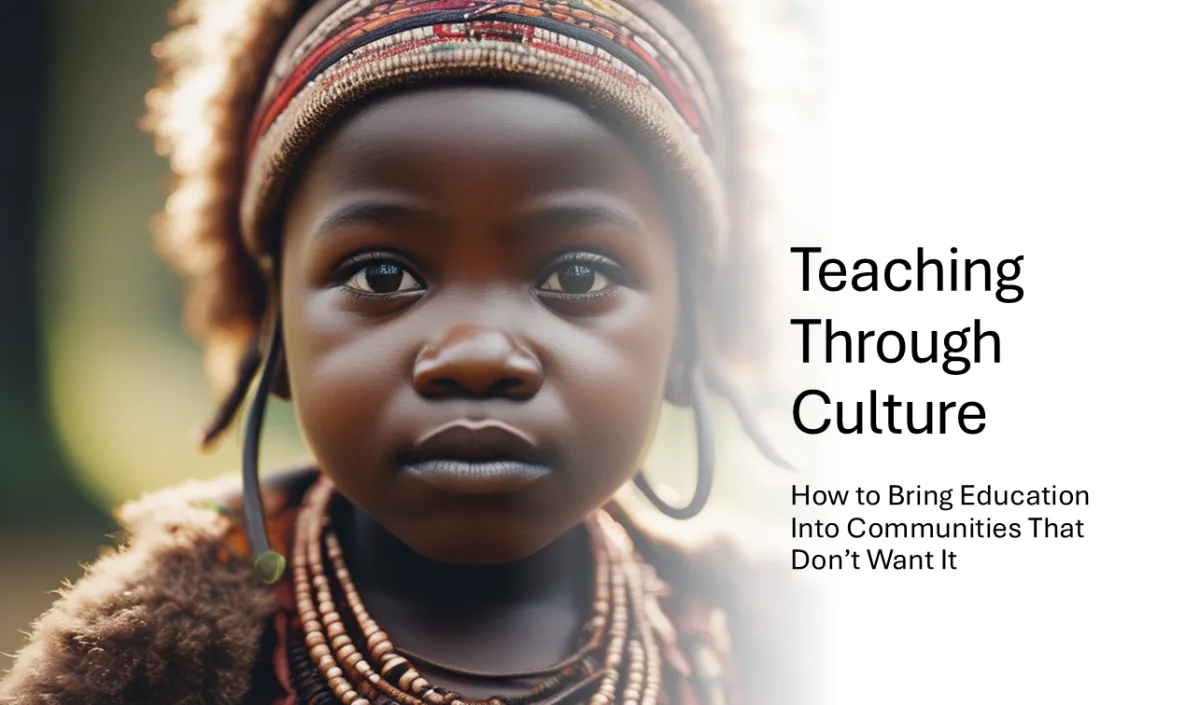
Teaching Through Culture: How to Bring Education Into Communities That Don’t Want It
Some communities welcome education with open arms.
Others want nothing to do with it.
Sometimes it’s due to tradition.
Sometimes fear.
Sometimes generational beliefs about what children — especially girls — should or should not do.
And as educators, our instinct is to push harder, convince louder, or impose our version of what “education” should look like.
But that never works.
Real change does not begin by challenging culture.
It begins by working within it.
If a community rejects formal schooling, the question is not “How do we make them want education?”
It is:
“How can education grow from the seeds already planted in their daily life?”
This is how we bring learning to places that resist it — by honoring their traditions, not erasing them.
1. Education Must Enter Through a Door That is ALREADY Open
Every culture has its own rhythms, values, and non-negotiables.
Trying to replace them with textbook learning feels like an attack on identity.
But when education walks in wearing the clothes of their own culture, it becomes familiar, helpful, and welcomed.
For example, in some communities, girls’ lives revolve around marriage preparation, homemaking, and food work from a very young age.
To them, academics feel irrelevant.
But education doesn’t have to look like a classroom.
It can look like:
Reading a recipe
Measuring ingredients
Writing down variations
Understanding why dough rises
Knowing how to preserve food safely
The moment learning becomes useful, it also becomes valued.
2. Use Their Daily Tasks as Hidden Curricula
Learning Through Cooking
Cooking is rich with educational possibilities — literacy, math, chemistry, microbiology, even economics.
If girls can read, they can:
Try new recipes
Follow cooking instructions
Record their own discoveries
Keep family recipes alive
Modify dishes with confidence
If they understand basic science, they can cook better and safer:
How yeast works
Why dough needs resting
Why salt enhances flavor
Why oil emulsifies
How bacteria make yogurt
Why food spoils
How brining and pickling preserve food
Learning Through Cleaning and Home Management
Even cleaning has science behind it:
How soap breaks down grease
Why hot water cleans better
Why scrubbing works
How to remove stains
Why some fabrics need gentler soap
Learning through building a house
·What materials can be used to make the roof waterproof so that it doesn’t leak?
·How to interlock logs and why it works?
·How can the floor be made smooth?
·How to place the windows for better sunlight or ventilation
·How to control the climate inside the house without needing any cooling or heating devices
Learning through growing crops
·How much water does a particular plant need
·How much sunlight does it need? What happens if it gets too much sunlight or too little of it?
·What nutrients does it require to grow well?
·What pests and diseases can affect it and how to prevent them?
·What plants grow well together and which ones don’t?
Suddenly, education is not something “outsiders” are forcing.
It is a tool that makes them better at the work they already take pride in.
When children understand the “how” and “why,” the daily tasks they already do become opportunities for growth — not mindless chores.
3. Start with what they already know through experience
In communities where the entire economy revolves around animals, the classroom is already there — grazing fields, barns, and the daily work of caring for livestock.
These families have incredible practical knowledge passed down for generations.
What teachers can do is connect that practical wisdom with scientific understanding:
Why certain foods strengthen animals
How digestion works in different species
What signs indicate illness
How wounds heal
Why certain herbs work
How breeding patterns function
How vaccination protects a herd
Why weight, gait, and bone structure matter in animal trade
This does not dismiss their traditions.
It deepens them.
It validates their identity and makes learning feel like a natural extension of who they already are.
4. Honor Their Knowledge Before Sharing Yours
Before teaching anything new, educators must first say:
“You already know so much. Let’s learn the why behind what you do.”
This simple shift changes everything.
Communities feel respected, not corrected.
They see their culture as the starting point, not a “problem to fix.”
And knowledge becomes a bridge, not a battle.
5. Introduce Small, Practical Lessons That Immediately Improve Their Life
Education feels irrelevant when it produces no visible change.
So give them micro-lessons that show immediate value:
How to prevent milk spoilage
How to calculate a fair price when selling animals
How to read simple labels on medicine bottles
How to treat common infections safely
How to measure ingredients consistently
How to reduce food waste
How to safely store grains
When people experience the benefits, learning becomes desirable, not forced.
6. Education Should Validate, Not Replace, Native Culture
The goal is not to convert communities to Western-style schooling.
The goal is to show that education strengthens the culture they already treasure.
For girls learning cooking:
Education makes them better cooks, safer food handlers, better managers of home-based microbusinesses.
For pastoral families:
Education strengthens animal care, improves trade outcomes, and reduces preventable losses.
For farming communities:
Education helps them understand soil, seeds, pests, weather patterns, and modern tools.
The culture stays.
The mindset expands.
The community evolves without losing itself.
7. Change Happens One Relationship at a Time
To teach a resistant community, you must first be welcomed by one family.
One mother who sees the value.
One father who is curious.
One child who wants to try writing her name.
Transformation doesn’t happen in schools first.
It happens in kitchens, fields, courtyards, and cattle sheds — quietly, relationally, respectfully.
8. Culture is Not a Barrier — It Is the Foundation
The biggest mistake educators make is assuming:
“Education must replace old traditions.”
The truth is:
Education must illuminate them.
It must help people see the “why” behind what they already do so beautifully.
When we teach through culture, not against it:
Resistance turns into curiosity
Curiosity turns into confidence
Confidence turns into empowerment
Empowerment turns into generational change
And eventually, education stops feeling foreign.
It becomes part of the community’s own story.
Final Thought: Build With Them, Not For Them
Communities that resist education are not rejecting learning.
They are rejecting what feels irrelevant or disrespectful to their lives.
But when education grows naturally from their culture — their food, their animals, their traditions, their stories — it becomes meaningful.
It becomes powerful.
It becomes theirs.
To transform a community, don’t start with textbooks.
Start with their world.
Start with their hands, their homes, their daily lives.
Because that is where real education begins — and where it belongs.