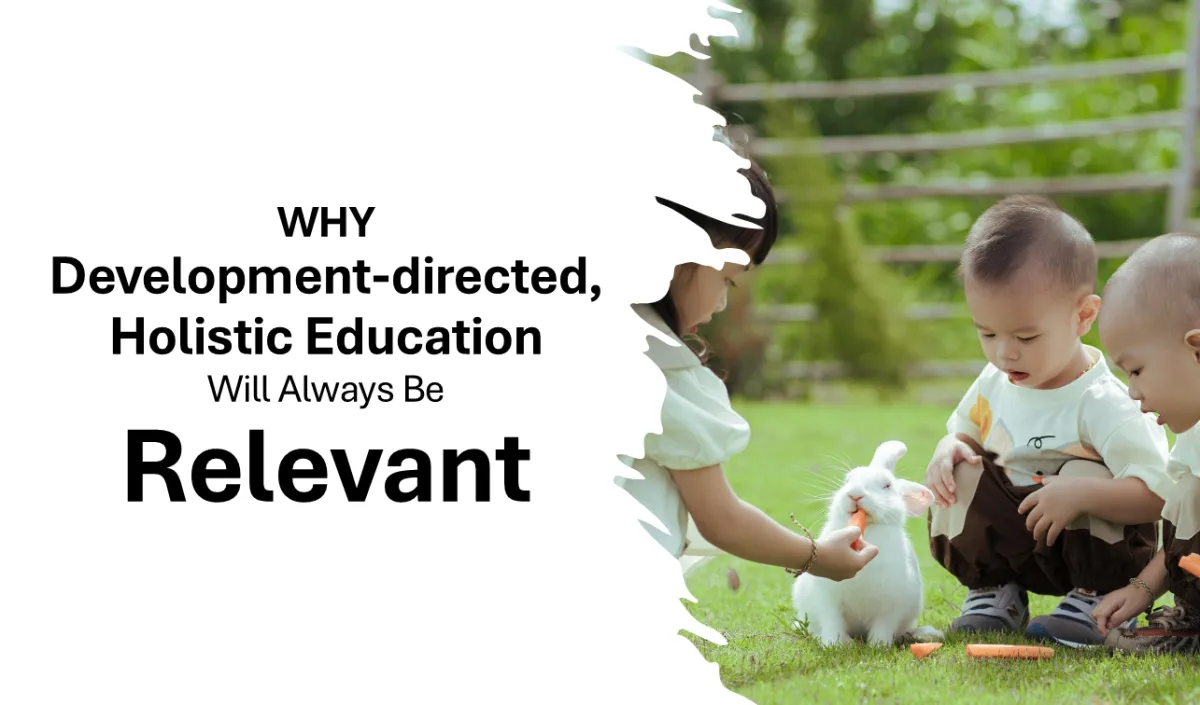
Why Developmentally Appropriate, Holistic Education Will Always Be Relevant
Educational models come and go. Syllabi change. Technologies evolve. Policies are rewritten.
Yet one thing has remained remarkably stable across centuries, cultures, and continents:
The way human beings grow.
Children today develop in fundamentally the same way children did a hundred years ago. The timeline may shift slightly. Contexts may differ. But the underlying developmental characteristics and needs of childhood and adolescence remain largely unchanged.
The sequence in which children acquire physical coordination, language, reasoning, emotional regulation, social awareness, and moral understanding remains biologically grounded.
These are not trends.
They are developmental realities.
Development-directed education begins by acknowledging this simple truth:
children have developmental needs, and those needs must be met for optimal growth. That is precisely why development-directed holistic education is timeless—and why it will always be relevant, anywhere in the world.
When education aligns itself with development, learning flows more naturally. When it works against development, learning becomes forced, fragile, and short-lived.
Education must prepare children for the adults they will become
Development-directed education is constructed with the future in mind.
The central question is not:
“How do we finish the syllabus?”
But:
“What should these children be capable of when they grow into adults?”
Every choice—what to present, when to present it, and how—is guided by that question. The aim is not short-term performance, but long-term human competence: the ability to survive, thrive, contribute, and live responsibly in the real world.
Development is universal. Context is local.
A healthy baby born in a refugee camp, a remote forest tribe, or a wealthy urban household will display remarkably similar developmental characteristics. What differs is not the child, but the environment.
Development-directed education is therefore inherently cross-cultural.
Because it is rooted in universal human development, it can be adapted to:
any culture,
any geography,
any belief system,
any socioeconomic context.
The principles remain the same.
The materials and expressions change.
Education can be local and global at the same time.
It is economically flexible, not resource-dependent
Development-directed education does not depend on expensive infrastructure or commercial materials.
A concept can be taught using:
a store-bought model, or
handmade materials, or
the natural environment itself.
A river can be studied using a costly model—or by shaping wet clay and stones into a mountain and watching water flow. The learning does not reside in the object, but in the experience and understanding it enables.
This makes the approach feasible for both affluent and resource-constrained settings, without compromising educational integrity.
Developmental characteristics guide what, when, and how
When educators understand developmental characteristics, decision-making becomes clearer.
For example:
Children aged 0–6 learn primarily through their senses and movement.
Abstract reasoning and imagination are neurologically limited at this stage.
Sensory training lays the foundation for later intellectual work.
Rather than forcing abstraction prematurely, development-directed education:
trains the senses first,
uses concrete materials to allow the hands work with the concepts before the mind assimilates it,
and allows abstraction to emerge naturally when the brain is ready.
This sequencing respects how the human brain develops.
Learning follows a pathway, not a syllabus race
There is no burden of “finishing” a syllabus.
Instead, there is a scaffolded pathway where each lesson grows organically out of the previous one as the child’s capabilities develop. Ironically, when learning is aligned with development, syllabi that once felt impossible often get completed naturally—without rush or stress.
Observation replaces rigid planning
Development-directed education is grounded in observation.
When educators understand development and know what to observe, they are rarely uncertain about what to present next. The child’s engagement, struggle, repetition, and mastery provide constant feedback.
Teaching becomes responsive rather than prescriptive.
Choice fuels responsibility and deep engagement
Children work best when their curiosity is respected.
When adults impose content based on their own priorities, children often disengage. But when children are allowed to choose meaningful work within a prepared environment, they:
work with joy and concentration,
persist longer,
and develop independence and responsibility.
Learning becomes something they own.
Mastery emerges through repetition, not pressure
Human beings possess a natural tendency toward perfection—not perfectionism, but the desire to refine, understand, and master.
Children will return to the same concept repeatedly, exploring it from different angles, testing its limits, and deepening understanding—if they are given time.
Current education systems rarely allow for this depth. Development-directed environments do. As a result, concepts become rock-solid, not memorized and forgotten.
The teacher steps out of the center
In development-directed classrooms, the teacher is not the focal point.
The environment is carefully prepared, expectations are clear, and children work independently or collaboratively. The educator becomes an observer, intervening only when guidance is requested or genuinely needed.
Noise during discussion is not disruption. Silence during deep work is common. Even young children learn to resolve conflicts independently within clear boundaries.
Individual pace is respected
Children do not learn at the same speed, nor in the same way.
Within the same classroom, some grasp concepts quickly, others steadily, others slowly—and these patterns vary by subject. Development-directed education accommodates this reality.
Fast learners are not bored.
Slower learners are not panicked.
No child internalizes the belief that they are “useless.”
Research, experimentation, and real thinking flourish
Independent research, experimentation, and record-keeping are integral—especially in middle childhood and adolescence.
Children remember most deeply what they:
investigate themselves,
test through trial and error,
and document thoughtfully.
Mistakes are not failures; they are data.
Practical life is not an add-on
Practical life skills—maintaining environments, preparing food, caring for shared spaces—are central, not peripheral.
When children participate in real work:
classrooms stay orderly,
children eat more mindfully,
responsibility becomes natural.
The goal is functional adulthood, not academic display.
Failure becomes safe and instructive
Development-directed environments provide a safety net for failure.
Children are encouraged to take risks, fail safely, reflect, and try again. This builds resilience, diligence, and wisdom—qualities no test can measure.
“Academic Tools”, not subjects
Language and mathematics are treated as tools to be mastered, not subjects to be conquered. Humans naturally communicate and reason quantitatively long before formal instruction begins.
Research skills become a third essential tool—enabling discernment in an information-saturated world.
Skills are built from the most fundamental level upward, one layer at a time.
Mixed-age communities mirror real life
Real societies are not age-segregated.
Mixed-age environments allow children to:
lead and be led,
mentor and be mentored,
develop meaningful social bonds.
This reflects the world they are being prepared to enter.
The hand leads the mind
Nothing is given to the head before it is given to the hand.
Children learn concretely and sensorially before abstract reasoning is introduced. This is especially critical in early childhood, when sensory and sensorimotor development form the foundation for perception and thought.
Adolescence: application, not overload
Adolescents thrive when learning connects to real life.
They can:
start and run businesses,
manage finances,
produce, market, sell, and evaluate,
reflect on successes and failures.
Financial literacy becomes lived experience, not theory.
Expression, reflection, and unstructured time matter
Daily self-expression and reflection are essential for emotional development.
Children choose how to express themselves—through writing, art, music, movement, building, or silence. Unstructured time allows creativity, self-analysis, and emotional integration to occur.
Collaboration over competition
Development-directed education prioritizes collaboration over ranking.
There are no scores, ranks, or academic competitions. Children learn to plan together, build together, and grow together. Competition is reserved primarily for sports, where it serves a different developmental purpose.
The ability to work as a team is indispensable in adult life.
Why this approach endures
Development-directed holistic education does not depend on trends, technology, or ideology.
It works because it aligns with how humans grow.
As long as children develop as they always have—and they do—this approach will remain relevant. Not because it is fashionable, but because it is fundamentally human.