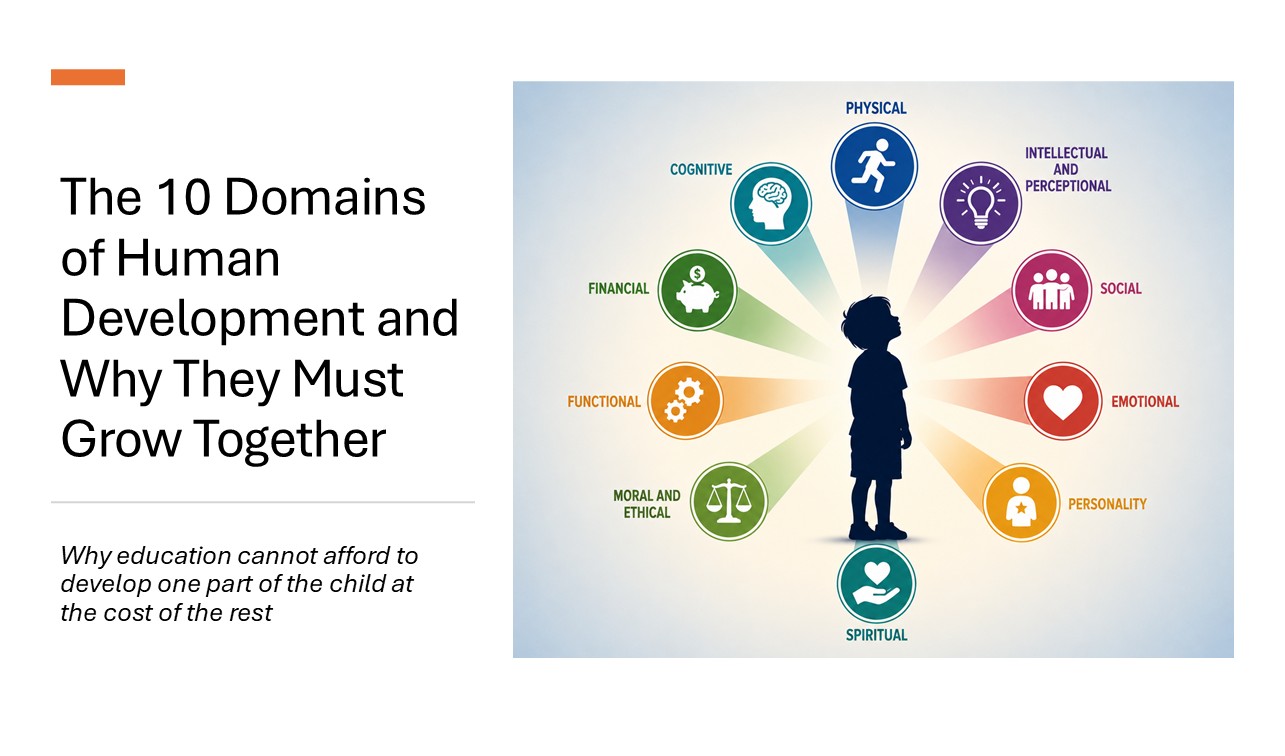
The 10 Domains of Human Development and Why They Must Grow Together
Domains of Human Development and Their Interconnectedness
When we speak about holistic education, we often use the word generously—but rarely precisely. To educate holistically is not to add more activities or subjects. It is to understand how human beings actually develop, and to nurture all the domains that together make a person capable of surviving, thriving, and contributing meaningfully to the world.
At Lifeskool, we work with ten domains of human development. These domains are not independent silos. They are deeply interconnected, developing at different rates across the lifespan, yet constantly influencing one another.
Before we explore how these domains interrelate, it is important to understand what each domain includes, and why it matters.
The Ten Domains of Human Development
1. Physical Development
(motor control, movement, sensory integration, coordination, nutrition)
Physical development forms the foundation of all other development. It includes gross and fine motor skills, balance, coordination, sensory processing, and bodily health.
From infancy, movement allows children to explore their environment. Through crawling, walking, touching, tasting, and manipulating objects, children gather the sensory data that feeds cognitive growth. Nutrition plays a critical role here—without adequate nourishment, neither the body nor the brain can develop optimally.
Physical development is not merely about fitness. It is about giving the child a body capable of engaging with the world.
2. Cognitive Development
(how knowledge is acquired)
Cognitive development concerns how learning happens—how the brain processes information, recognizes patterns, retains memory, sustains attention, and acquires foundational skills such as language and mathematics.
Developmental psychologists, most notably Jean Piaget, showed that children do not think like miniature adults. Cognitive abilities unfold in stages, each building on earlier experiences. At Lifeskool, we view cognitive development as the input system—how knowledge enters the mind.
This includes:
language acquisition
mathematical thinking
sensory perception
attention and memory
learning how to learn
Cognitive development is necessary, but not sufficient, for mature understanding.
3. Intellectual and Perceptional Development
(application, reasoning, worldview formation)
While cognitive development is about acquiring knowledge, intellectual development is about using that knowledge—reasoning, analyzing, making connections, forming arguments, and making decisions.
Perceptional development refers to how one’s understanding of the world changes with experience. As children grow and are exposed to diverse realities—through lived experience, books, travel, conversations, and reflection—their interpretations deepen and mature.
These two are closely related but not identical:
Cognitive: What do I know?
Intellectual: What can I do with what I know?
Perceptional: How do I now see the world differently?
4. Social Development
Social development is the ability to live and work effectively with others. It includes communication, cooperation, conflict resolution, understanding social roles, and building relationships.
Children are inherently social beings. They learn social norms first within the family, then in broader communities. Healthy social development requires real interaction, not merely instruction—collaborative work, discussion, shared responsibility, and mixed-age interactions.
5. Emotional Development
Emotional development involves understanding, expressing, and regulating emotions. It shapes resilience, self-control, empathy, and mental well-being.
Children need time and space for self-expression and reflection. When emotional development is neglected, children may appear compliant or high-achieving, yet struggle internally with anxiety, burnout, or emotional dysregulation.
6. Personality Development
Personality development concerns the formation of identity—Who am I? What am I like? What do I value? It integrates temperament, self-concept, confidence, and character traits.
A stable personality allows individuals to navigate life with consistency and integrity rather than being swayed by external pressures.
7. Spiritual Development
Spiritual development addresses questions of meaning, purpose, and transcendence.
At Lifeskool, we ground this domain in a Christian worldview. The Bible presents humanity as created in God’s image—dignified, capable, yet fragile and prone to moral failure. It also introduces the creation and dominion mandate: not exploitation, but responsible stewardship.
Dominion, in the biblical sense, resembles the rule of a wise king—ensuring that the needs of those under his care are met, that peace is preserved, and that resources are used wisely.
Without spiritual grounding, human power often turns inward—toward selfishness and cruelty.
8. Moral and Ethical Development
Moral development concerns right and wrong, justice, integrity, and accountability. Ethical frameworks guide behavior, especially when external supervision is absent.
Moral development is inseparable from spiritual development. While individuals may draw their moral foundation from different sources, what matters is that it produces integrity and responsibility toward others.
Children learn morality far more from observation than instruction. Adults are always teaching—whether they intend to or not.
9. Functional Development
Functional development refers to the practical skills required to care for oneself and one’s environment—personal hygiene, home maintenance, social etiquette, and daily life management.
Although often ignored in formal education, functional competence is essential for independence and dignity. A person who cannot manage daily life struggles to thrive socially or economically.
10. Financial Development
Financial development involves earning, managing, saving, investing, and building wealth responsibly.
Money is not evil; it is a tool. The love of money—unchecked and unanchored by ethics—is what leads to harm. Financial development plays a crucial role in breaking generational poverty and enabling individuals to contribute productively to society.
All other domains ultimately support this one—not for accumulation, but for honorable, sustainable living.
Interconnectedness: How the Domains Influence One Another
These domains do not develop evenly or independently.
Physical development is most intense in early childhood
Cognitive development accelerates in middle childhood
Intellectual and perceptional development expands during adolescence
Social and emotional development deepen in early adulthood
Financial development becomes prominent when earning begins
Yet all domains (other than financial) are active at every age, even if subtly.
Consider infancy:
A baby recognizes their mother’s face and smell through sensory (physical) input. This becomes the first cognitive recognition, the first social bond, and the first emotional regulation. The infant also begins rudimentary reasoning: When I have needs, someone comes.
If these early experiences are disrupted, maladaptive behaviors often emerge later.
Physical → Cognitive → Intellectual
Movement enables exploration. Exploration enables cognition. Cognition enables reasoning.
A child who lacks physical coordination may explore less, limiting cognitive input. This, in turn, constrains intellectual growth. Development builds from the body upward, not the other way around.
Personality, Emotional, Social, and Spiritual Interdependence
Identity (Who am I?) is a spiritual question. Emotional stability depends on how one sees oneself within the world. Social behavior reflects both.
A strong spiritual foundation provides stability amid uncertainty. It teaches compassion, discernment, and accountability—essential for healthy relationships.
Moral, Functional, and Financial Development
Poor financial decisions are often driven by:
emotional dysregulation
social pressure
weak identity
lack of ethical grounding
Functional incompetence may stem from physical or cognitive deficits. Knowledge without application reflects weak intellectual or perceptional development.
Misuse of money often reveals moral and spiritual gaps, not financial ignorance alone.
The Role of the Adult and the Environment
All domains will develop. That is inevitable.
What is not inevitable is how they develop.
Adults shape development through:
the environments they prepare
the materials they provide
the mistakes they allow
the boundaries they set
the role models they embody
A child grows into what the environment quietly teaches.
Where Most Schools Fall Short
Most schools heavily emphasize cognitive development through textbooks. Some physical development is addressed through sports. The rest receive minimal attention.
Intellectual development is constrained by syllabus pressure.
Social development is weakened by limited collaboration.
Emotional development is neglected due to lack of reflection.
The result is cognitive overload, stress, and fragmented understanding—knowledge without meaning or application.
Why Holistic Development Is Non-Negotiable
To produce functional, financially stable, ethically grounded adults, all domains must develop in harmony.
Holistic education is not an ideal.
It is a biological, psychological, and social necessity.
When education aligns with human development, children don’t just learn—they become.
And that is the true purpose of education.